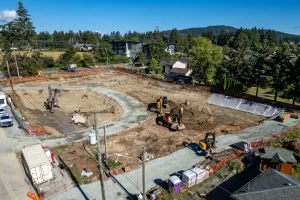
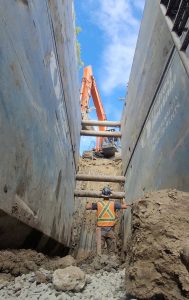
Dig deep enough on southern Vancouver Island and you will hit rock. Sometimes it sits well below anything the project needs to touch. Other times it’s a few feet under the topsoil, right where the foundation or a sewer main is supposed to go. In those cases, it has to be removed, and the method chosen will shape the budget and schedule for weeks.
Rock Changes the Job
Ground conditions across the Capital Regional District can shift over a short distance. One corner of a lot might be clay while the opposite corner has rock at shallow depth. A test hole on one side of a site won’t necessarily tell you much about the other. The rock surface itself is rarely level, and it can rise or drop sharply within a single building footprint.
Organic materials and clay go straight into a truck. Rock has to be broken up first, either mechanically or by drilling and blasting, before an excavator can load it. The aim is to reach design grade as efficiently as possible without doing damage to adjacent properties.
Hammering
On smaller jobs the first tool out is usually a hydraulic hammer mounted on an excavator. It breaks rock a piece at a time. That suits infill lots, utility trenches, and work close to existing structures where blasting isn’t an option. Hammers are sized to the machine carrying them, from small units on mini excavators up to heavy-duty breakers weighing thousands of pounds for large machines.
The drawback is speed. Breaking rock this way takes a long time and wears hard on the machine, and on a large commercial footprint those hours add up. With enough rock on a site, drilling and blasting usually becomes the cheaper option.
Drilling and Blasting
The process starts with holes drilled in a planned pattern across the rock. Those holes are loaded and fired to fracture the rock in place, and the excavator then digs out loose material at a normal pace instead of fighting a solid shelf. A well-designed shot leaves pieces small enough for the excavator and trucks to handle.
Blasting is the most regulated part of rock work. In BC it has to be done by a certified blaster, and municipalities in the region have their own rules on when and where it can happen. Nearby buildings may be surveyed before the first shot so existing cracks are on record. Seismographs are commonly used to track vibration during the work. Blast mats are often laid over the shot to keep rock from flying.
You may also like this post: Working Around Tree Protection Zones on Southern Vancouver Island
Where the Rock Goes
Broken rock takes up more room than it did in the ground. That swell has to be accounted for when counting truckloads. Once it’s out, there are three main options for the material:
- Hauling it off site to a yard where it’s crushed into gravel or drain rock, or to a site that accepts clean fill.
- Keeping some on site as rough backfill or to build up and stabilize slopes.
- Crushing it on site with a mobile crusher, which makes sense on larger developments with enough volume to justify one. The result is aggregate for roads, pads, or later phases of the build, and less trucking in both directions.
Keeping the Trucks Moving
Moving rock off a commercial site takes a steady rotation of dump trucks. Every load needs a place to go. Receiving sites don’t all keep the same hours or accept the same material, and hundreds of trips through residential or downtown streets have to fit around traffic.
Matching trucks to the excavator takes planning. A line of trucks waiting on the street costs money, and so does an excavator sitting idle between loads. Round-trip times and loading rates can be worked out before digging starts, and the truck count set from there.
Finding It Before You Dig
Unexpected rock can wreck an excavation budget. Geotechnical investigation, with test holes spread across the site, gives estimators a rough picture of where the rock is and how much of it there is. It won’t catch everything, but it narrows the guesswork enough to price the job with some confidence and settle the removal method and trucking plan before the bucket hits rock.
Call the Professionals
Rock work rewards planning more than almost any other part of commercial excavation. The right removal method, a realistic trucking plan, and good information about the ground all come down to decisions made early. If you have a project coming up on the South Island, give us a call to talk through what’s under your site.