On commercial and civil projects, deep excavation usually means one thing: the deeper you go, the less margin for error you have.
Condominium parkades, multi-storey foundations, pump stations, infrastructure vaults and major utility corridors all push below typical residential depths. Some excavations are wide enough to slope safely. Others are tight, vertical, and unforgiving.
There is no fixed number that defines “deep.” Soil type, excavation width, groundwater, adjacent buildings, traffic loads, and vibration all change the equation.
Around Victoria, ground conditions can shift quickly. One area may be dense and stable. A few metres away, it may be sandy or previously filled. Add steady rainfall and sections of high groundwater, and stability becomes something you actively manage, not something you assume.
Planning, Ground Conditions, and Support Strategy
On larger commercial builds, excavation usually starts with a geotechnical report. On civil projects, soil data, buried services, and surrounding structures still need to be understood before digging starts. Surprises below grade are expensive.
If space allows and soils are stable, slopes can be cut back to reduce the risk of collapse. Where room is limited, benching may be used to break vertical faces into stepped levels.
When neither is practical, support systems are required. That may include conventional shoring, trench boxes, or engineered systems such as soil nailing with shotcrete and tiebacks to stabilize vertical faces.
Narrow utility trenches are a common example. Even at moderate depths, they may require trench boxes or engineered shoring systems. The width at the bottom, the soil classification, and nearby loads all factor in. Excavated material must be kept back from the edge. Spoil piled too close increases lateral pressure. That is a preventable mistake.
Where buildings, roads, or heavy traffic are adjacent to the excavation, support requirements increase. In some situations, written instructions from a qualified professional are required before work proceeds. That planning protects workers and nearby structures.
Related Post: Things To Consider When Hiring An Excavation Contractor
Water Management and Stability
Water changes everything.
Most deep excavations in Victoria will collect water at some point. Rainfall runs toward the lowest point. Groundwater seeps in from below or through the walls.
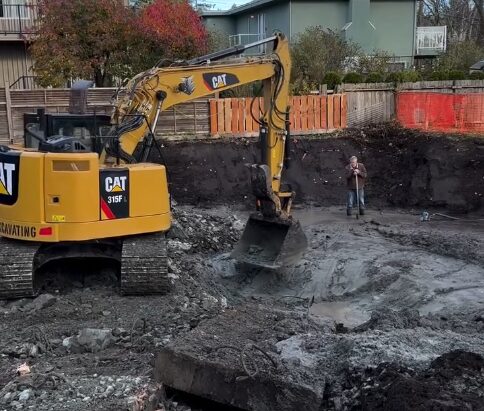
Surface runoff is typically redirected using temporary grading, berms, or swales so it never reaches the excavation edge. Inside the hole, sump pits are established at low points. Pumps run as needed to keep water levels down.
Allowing water to sit in the excavation is not an option. Saturated soil loses strength, slopes soften and shoring faces added pressure. Small issues become large ones quickly.
Water control is ongoing. After heavy rain, conditions are reassessed before work continues.
Excavation Sequencing and Site Access
Large building excavations are typically staged. Bulk material is removed in controlled sections, maintaining stable slopes and safe truck movement.
On deeper building projects, temporary access ramps allow excavators and haul trucks to move in and out safely. Ramp slope and surface condition matter. If equipment cannot travel safely, the job slows down or stops.
As final depth is approached, the ramp is reduced in stages. The last machine in the hole must have a clear plan to get out.
Often, an excavator will work itself backward up the remaining ramp while trimming it away. In tighter sites, a long-boom excavator from grade finishes the final cuts. If equipment is left below after ramp removal, it must be lifted out by crane. That lift is coordinated in advance, not improvised.
Utility excavations follow a different rhythm. They move linearly, supported as required, and are typically backfilled in sections once installation is complete.
Backfilling and Transition to Construction
Excavation is only half the job.
Backfill material must meet specification. It is placed in controlled lifts and compacted properly. Density testing is often required. Poor compaction leads to settlement, slab cracking, and long-term movement.
The ground you replace has to perform as well as, or better than, the ground you removed.
Related Post: How Weather Conditions Affect Excavation Projects In Victoria, BC
Choosing the Right Contractor for Deep Excavation
Deep excavation on commercial and civil projects demands planning, coordination, and discipline. It involves more than digging to depth. It requires understanding how soil behaves, how water affects stability, and how sequencing impacts safety.
Experience shows up in spoil placement, ramp design, and water control.
Erdem Excavating works with engineers, project managers, and inspectors to execute deep excavation safely and efficiently across Victoria and the surrounding area.
If you are planning a commercial or civil excavation project, contact us today to start the process.