
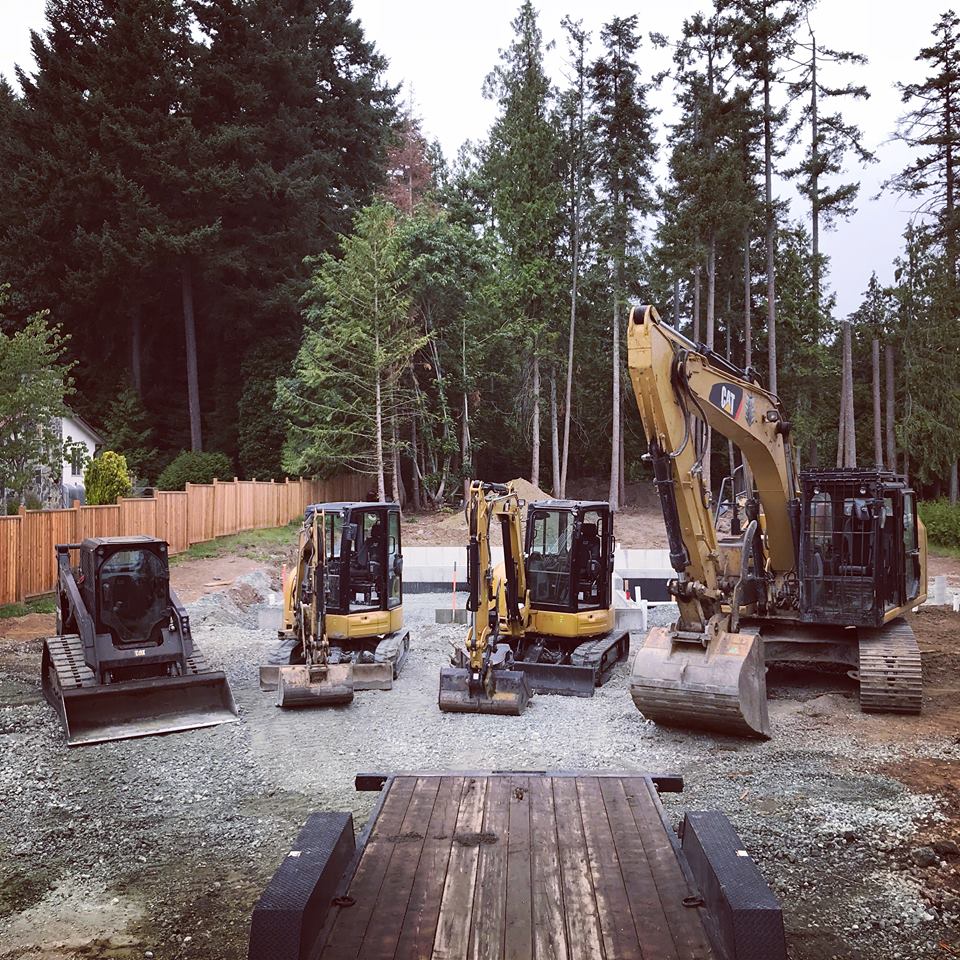
Different Types of Excavators Used in Victoria, BC
Excavation isn’t one-size-fits-all work. A mini excavator that’s perfect for a backyard landscaping work won’t accomplish much on a major commercial site. A 40-ton beast built for moving rock won’t fit through your garden gate.
Victoria’s got its own challenges too – plenty of rock and clay, narrow city lots in old neighborhoods, and everything from residential renos to major infrastructure builds. Here’s what actually gets used around here and why.
Crawler Excavators
These are the tracked machines most people picture when they think “excavator.” Tracks instead of wheels mean they can work on unstable and soft ground that would leave a wheeled machine stuck. Muddy sites, slopes, rough terrain – crawlers handle it. Within this category, machines range vastly in size.
Mini Excavators (1-6 Tons)
Don’t let the size fool you. Mini excavators punch way above their weight class.
They’ll fit through a 36-inch gate, work in a backyard without tearing up the lawn, and still dig deep enough for many residential foundations. Pool installations, landscaping, utility trenches – this is their bread and butter.
In Victoria’s older neighborhoods where lot access is tight and mature trees are everywhere, minis are often the only option that makes sense. You need something that can navigate without destroying what’s already there.
Related Post: Skid Steer Service in Victoria, BC
Mid-Size Excavators (6-30 Tons)
This is the workhorse range. Not too big, not too small. If you see an excavator on a Victoria job site, it’s probably in this category.
Foundations, land clearing, loading trucks, utility work – mid-size excavators do it all. They’ve got enough power to handle our rocky ground but aren’t so massive that they’re overkill for typical projects.
Most contractors run machines in this range because they’re versatile. You can keep one busy all day on jobs that would need three different pieces of equipment otherwise.
Large Excavators (30+ Tons)
When you need to move serious material, these are what show up. We’re talking machines in the 300-class and bigger.
Large commercial developments, major infrastructure, loading articulated trucks, breaking rock – these excavators are built for volume and force. In Victoria, you’ll see them on bigger construction sites where productivity matters and smaller machines can’t move the volume of material required.
Victoria’s bedrock doesn’t care about your schedule. Large excavators have the weight and power to rip through material that would bog down lighter equipment.
Long-Reach Excavators
Standard excavators reach maybe 20-30 feet. Long-reach models? Try 40-60 feet or more.
That extended boom matters when you’re digging deep foundations and can’t safely get equipment to the bottom. Demolition work where you need distance for safety. Excavating along slopes. Working over barriers. These machines can often be spotted at deep foundations in the city, digging out access ramps and other material from street-level.
Wheeled Excavators
Wheels instead of tracks. You give up some traction and stability, but you gain speed and road-friendliness.
Standard Wheeled Excavators (15-25 Tons)
The big advantage? They don’t chew up pavement.
Road work, utility installation along streets, highway maintenance – anywhere you’re working on finished surfaces or need to move between sites quickly. Wheeled excavators can travel on roads without a trailer, which saves time on jobs that cover multiple locations.
Some municipal crews use these machines to move quickly between sites and avoid damage to asphalt.
Related Post: Driveway Construction in Victoria, BC
Straight Boom Excavators (Gradall)
These look different because they are different. Instead of an two-piece boom, they’ve got a telescoping arm that extends straight out.
Gradall is the most common brand for this style of machine. The straight boom excels at precision highway work – ditching, grading, maintaining exact slopes, railroad work. The boom telescopes while holding precise angles, which matters when you’re finishing to grade.
You won’t see as many of these around Victoria as standard excavators, but for specialized municipal and highway work where precision beats raw power, they’re the right tool.
Backhoe Excavators
Backhoes aren’t technically excavators, but they do excavator work all over the place.
They’re the Swiss army knife of digging equipment. Loader bucket on the front, excavator arm on the back. A Cat 420F digs about 14-15 feet deep – enough for most utility work and smaller jobs.
Dig with the back, swing around and load with the front. One machine, one operator, multiple capabilities. That’s why you see backhoes on utility crews, municipal maintenance, and smaller commercial sites.
In Victoria’s urban environment, backhoes make sense when you need versatility more than maximum digging power. They’re mobile, efficient, and they eliminate the need for multiple machines on tight sites.
Related Post: Things to Consider When Hiring an Excavation Contractor
Other Specialized Excavator Types
Most excavation work in Victoria uses the machines above. But there’s a whole world of specialized equipment out there, even if you won’t see it on the Island.
Spider Excavators work on terrain that would be suicide for normal machines. Steep slopes, unstable ground – they’ve got stabilizing legs that extend out and let them work at angles that seem impossible. More common in mountainous areas where the terrain demands it.
Mining Shovels are what you use when “big” doesn’t cut it anymore. These monsters load mining trucks that carry hundreds of tons. Way beyond anything needed for Vancouver Island construction.
Draglines hang a massive bucket on cables and swing it around to move enormous volumes of material. Mining operations, major earthmoving projects – the scale’s just not relevant here.
Swamp Excavators (also called amphibious excavators) float on extra-wide pontoon tracks. They work in wetlands and marshes where nothing else can go. Victoria’s got wetland areas, but projects needing these are rare. Environmental restoration work, specialized dredging – it happens, just not often.
Choosing the Right Excavator for Your Victoria Project
Project scope, site access, ground conditions, the specific work you’re doing – it all matters.
Victoria’s rocky ground breaks equipment that’s not up to the job. Narrow urban lots won’t fit machines that are too big. Residential neighborhoods need equipment that won’t destroy driveways and landscaping.
Good contractors know this stuff. We match the machine to the job instead of forcing whatever equipment they happen to have available. Right equipment from the start means the job gets done on schedule and on budget.
If you’re planning excavation work in Victoria, give us a call. We maintain a diverse fleet of excavation equipment suitable for any Southern Vancouver Island excavation project. Contact us today to discuss your project and figure out the right approach before equipment shows up on sit

